


Teaching Claude How You Work
Posted in Agile Development, Artificial Intelligence, Business Analysis, Change Management, Product Development on 11th September 2026
The Shift from better prompts to reusable AI skills
For a long time I considered better prompting to be the key to achieving better results.Whenever Claude overlooked something, I included more context. When the tone was incorrect, I gave a more careful explanation of the tone. If the output was inconsistent, I added some examples. And if the output still wasn't behaving as I wanted, then the prompt was just made longer.It worked up to a certain point.Although the outputs got better, the process associated with them did not.
I was carrying on giving the same instructions each time, stating how the work should be tackled, which standards were important, what ought to be done in normal situations, what had to be checked, where a judgement was needed, and what "good" meant before the work could be regarded as complete.Eventually, it became evident the real problem wasn't prompting.
I used to explain over and over again how things should be done. At that point Claude Skills began to make a great deal more sense to me. A prompt is useful for an immediate, specific task, while a skill proves useful when the same kind of work keeps coming up, and the method is stable enough to reuse.Most professional work already uses methods.
Importance of skills over prompting
There are certain ways in which things should be done. Templates, checklists, review points, known exceptions, and situations in which a person is expected to take action all exist. In some cases, these are set out in a standard operating procedure; in other cases, they exist only in the minds of people who have been doing the work for many years.In any case, the procedure is there.
What interested me was the idea of making that procedural knowledge usable for Claude rather than having to explain it once in each conversation. I got a clearer understanding of this when I was involved in digital transformation and dealing with recurring operational workflows.Consider a typical engagement and event process.
Skill reusability
Information is received from a variety of sources. It is necessary to check previous communication. Identify any missing information. Routine tasks can get underway quickly, but unusual requests, conflicting information, or sensitive reviews require a pause to review them properly.Claude can assist with the various stages of that process through prompting.
Yet if, with each task, a person has to explain the same standards manually, check the same conditions, and remind the system what to do when something goes wrong, then very little has actually been standardized.The system could be assisting with the task even though the person is still mentally carrying out the process.At this point, a reusable skill becomes more valuable than a better prompt.
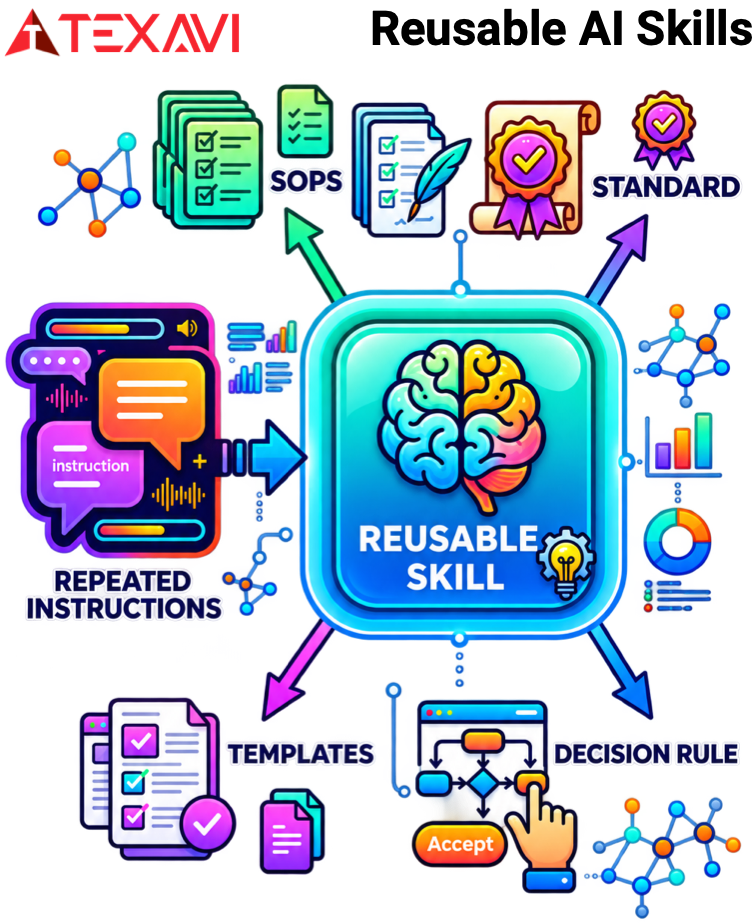
The operating method doesn't need to be explained over and over again since the method can be arranged instead.For any recurring workflow, this could include standard operating procedures, approved templates, communication standards, quality checks, decision rules, examples of acceptable outputs, known exceptions, and the conditions that should trigger human review.
Instructions and their relationships
The fact that you instruct Claude on how to prepare a communication is only one aspect of the task; it also has to know what information must be available before it carries on, which source should be given priority in the event of a conflict between two inputs, what sort of cases are outside the normal procedure, and when the work should cease and be handed back to a person.That's much closer to how real operations work.In a particular digital transformation workflow, the standard route was that simple.
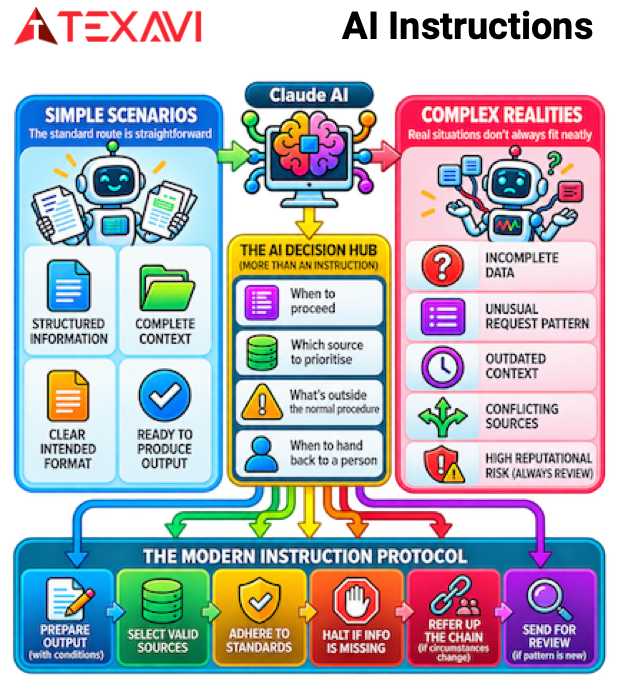
Information arrived in a structured form, the necessary context was at hand, the intended format was known, and Claude had no great difficulty preparing the next output.What made the situations more interesting was that the process didn't fit neatly.The information could be incomplete, the request might not conform to the normal pattern, the context might have changed since the procedure was drafted, two sources might give conflicting accounts, and a communication might have such reputational significance that it should never proceed without review.
Working with procedures
As with routine cases, the operating procedure should include these situations.So the useful instruction is not simply: “Prepare this output”. It is closer to: 'Prepare the output whenever these conditions are met. Use those sources. Adhere to these standards. If the information in question is missing, halt the process. If these circumstances arise, refer the matter up the chain. If the case does not conform to the usual pattern, send it for review'.
That is where I see Claude's real value. The ability to apply it to a repeatable process, since the person need not reconstruct the process from memory every time, is also why I consider standard operating procedures a practical application. Many organisations already have standard operating procedures in documents which are expected to be read, remembered, and applied correctly.
The document is there, but the procedure remains disconnected from the moment when the work takes place.If you can make the relevant sections of that procedure available within a reusable skill, Claude will apply the operating rules as it carries out the work.The fact remains that people are still needed and that it makes the role of humans clear.
The consistent sections can be handled uniformly, and the ones that require a lot of judgment can stay with the person accountable for them.A well-designed skill therefore consists of only a few clear components.The principal instructions explain the usual way in which the work should be carried out.Reference material provides the standards and examples. Templates help keep routine outputs the same.
Rules and checks
The decision rules make it clear which cases should follow the normal course and which ones call for attention. When a deterministic outcome must occur the same way each time, use a script rather than asking the model to improvise.Together, these sections start to feel less like a prompt and more like an operational playbook.It's useful, but it comes at the cost of introducing risk.Even if the procedure is of poor quality, Claude won't automatically make it better.
A vague standard operating procedure can result in a vague skill. An obsolete rule might be applied more consistently, which could actually make the problem worse. A poor process doesn't become strong just because it's neatly packaged, which is why human evaluation still has its place.Before relying on a skill you use repeatedly, I would like to check it against the kinds of situations that actually happen.
- Does it work correctly in the ordinary case?
- What is the result when an input that is required is missing?
- Does it recognize an exception?
- Does it stop at the right time?
- Does the result meet the standard that one would expect?
- Can it tell when it doesn't have enough information to go on?
These checks are just as important as the initial build.That is also true once the skill has been put into use.People should note that they keep correcting Claude that way.If reviewers consistently disregard the same recommendation, then a part of the procedure is missing.It shouldn't be an exception if an 'exception' starts to occur every week.This shows that the existing knowledge should be updated.This is where skills prove more interesting than static prompt libraries.
Skills vs. prompt libraries
A prompt library preserves. A skill can keep a method of working alive while developing as that method becomes better understood. The cycle is quite simple.s The work is being carried out. is carried out.Someone assesses the result.The correction shows a point which had been omitted from the procedure.The skill is updated.The following piece of work is based on an improved version of the process.Over time, the value lies less in remembering a good prompt and more in reusing the experience.There is also a practical reason why one enormous instruction should not be used to contain everything.
Not every task needs all available context.For a routine task, you only need the basic operating procedure and a template.In some instances, you will need additional reference material.A specialist task may require a different set of instructions or a script.Organising those communications makes it easier to maintain and understand the process.That also means you can make changes in the right place.When the communication standard changes, update it.
The skill can evolve without becoming a single oversized prompt that nobody wants to touch because no one remembers why half of it is. I would still deliberately keep one boundary human. A skilled person can carry out procedures, check standards, identify known conditions, route the work, and make recommendations.It doesn't mean that it should make every decision.In high-consequence cases, conflicting contexts, unusual situations, and any instance where reputation, people, or important organizational judgment is involved, a clearly identified human owner is still needed. The division of labour is about as simple as it can be.Claude handles the reusable parts of the procedure.
Conclusion
People assess the outcome, handle the exceptions, and still take responsibility for decisions with real consequences.That is how I would like these systems to function.The way we move from prompts to skills therefore alters the question that I ask.It is no longer simply:How can I make this task clearer?. The more useful question are:
- What exactly is needed to do this work properly?
- What are the procedures that experienced individuals adhere to?
- What information do they depend on?
- What do they check before something moves forward?
- Which cases are routine?
- Which cases need judgment?
- What should happen when the process no longer fits the situation?
When the answers are clear, they can be reused.That is the part of Claude Skills I find most valuable.The benefit is not that Claude remembers a preference or follows a template.The benefit is that you can make a way of working explicit, apply it consistently, have people evaluate it, and improve it over time.A prompt can improve one interaction.A well-designed skill can make the work itself easier to repeat well.
 ® and Analyst Zone® © Since 2017 Texavi Innovative Solutions